
"What is your secret to teaching your son Math facts?"
This was what my first grader's teacher asked me just recently. I stood there for a moment wishing I had an explanation, some novel strategy of teaching that caused my child to succeed in this unforeseen math assessment that day.
But I did not have a specific strategy. To tell you the truth, I had done nothing to promote his quickness in solving addition and subtraction problems in his head.
I relayed to his teacher that both his older brother and him have a way with seeing the numbers in their head and solving problems as they seem to be drawn to strategic things.
It was only later that I thought of the visual process of math solving in your head and comparing it to the visual process of signing.
Here's some thing to consider in the process of signing and Mathematics:
Learning to talk, thinking of the need they wanted to express in words, not knowing how to say it, visualizing the sign that would produce that same word they wanted to express. And then signing what they wanted to express.
Math being a similar problem solving situation.
Thinking of the problem (addition or subtraction) and what needs to be expressed (the sum or difference), not knowing the answer readily, visualizing the numbers and producing an answer in their mind. Being able to then answer the problem.
So when asked next time what is my secret in teaching my children math facts, I just might start with the notion of how using sign language at a young age may have enhanced the ability to visualize problems and solve them in their head.^_^
By Shawna Tran


CLASSES AND PROGRAMS
PRODUCTS
DVDs
CDs
Books
Flash cards
Board books
Toys
Others
Share products
FUN
Pictures
Videos
Share your pic
and video

Signing With Babies And Children
Thursday, March 14, 2013


Wednesday, July 4, 2012
Animal Signs ~ Make it Fun
Hello my fellow signing friends. It's been a long time, and I miss contributing to this wonderful signing adventure. We are expecting our fifth child, and I hope to continue to contribute ideas that will help engage new ideas in your individual signing journeys with your little ones!
Today, I wanted to write about animal signs and how we can make them fun. There are many animal books out there to read to your little ones. The first one that comes to mind is Eric Carle's Brown Bear, Brown Bear, What Do You See?
Eric Carle has many other versions of this book, and there are many other animal board books out there that are engaging and fun for your children to learn their animals and their signs.
When learning animal signs, you can help your child remember the word and the sign by creating a fun visual with the sign itself. Here are just a few ideas below.
5 Tickle Animal Signs:
Tiger - tickle across the face
Zebra - tickle across the the tummy
Snake - make sign while going on towards neck or tummy and tickling
Giraffe - tickle the neck while going down
Bear - hug behind their back, crossing arms, tickle up by shoulders (bear hug)
5 Sound Animal Signs:
Cow - bring the sign towards the face and back saying "moo"
Horse - bring the sign up and down saying "nay, nay"
Pig - bring the sign under chin, moving fingers in and out saying "oink, oink"
Cat - bring the sign across the face saying "meow"
Dog - bring the sign on and off from your leg saying "rough, rough"
5 Description Animal Signs:
Bird - form the bird's beak with one finger, open and close
Duck - form a bigger bird beak with two fingers, open and close
Peacock - sign bird and then form feathers of a peacock
Goat - form the goat's beard and then horns
Panda - form a "p" circling around the panda's black fur eye
5 Water Animal Signs:
Fish - sign a fish swimming side to side, moving forward in the water
Dolphin - sign a dolphin coming in and out of the ocean water
Shrimp - sign a little shrimp swimming across the water
Shark - sign the shark's fin on top of the water
Octopus - sign the legs of the octopus moving in the water
Please add any other ideas you have. The options are endless as we can each create our own visual effects and sound effects that help children learn their animal words, signs, and sounds. Make it fun for the both of you!
Oh, and if you get a chance to visit a zoo this summer, have a wonderful time with the world of signs and animals!!
Written by Shawna Tran.
Today, I wanted to write about animal signs and how we can make them fun. There are many animal books out there to read to your little ones. The first one that comes to mind is Eric Carle's Brown Bear, Brown Bear, What Do You See?
Eric Carle has many other versions of this book, and there are many other animal board books out there that are engaging and fun for your children to learn their animals and their signs.
When learning animal signs, you can help your child remember the word and the sign by creating a fun visual with the sign itself. Here are just a few ideas below.
5 Tickle Animal Signs:
Tiger - tickle across the face
Zebra - tickle across the the tummy
Snake - make sign while going on towards neck or tummy and tickling
Giraffe - tickle the neck while going down
Bear - hug behind their back, crossing arms, tickle up by shoulders (bear hug)
5 Sound Animal Signs:
Cow - bring the sign towards the face and back saying "moo"
Horse - bring the sign up and down saying "nay, nay"
Pig - bring the sign under chin, moving fingers in and out saying "oink, oink"
Cat - bring the sign across the face saying "meow"
Dog - bring the sign on and off from your leg saying "rough, rough"
5 Description Animal Signs:
Bird - form the bird's beak with one finger, open and close
Duck - form a bigger bird beak with two fingers, open and close
Peacock - sign bird and then form feathers of a peacock
Goat - form the goat's beard and then horns
Panda - form a "p" circling around the panda's black fur eye
5 Water Animal Signs:
Fish - sign a fish swimming side to side, moving forward in the water
Dolphin - sign a dolphin coming in and out of the ocean water
Shrimp - sign a little shrimp swimming across the water
Shark - sign the shark's fin on top of the water
Octopus - sign the legs of the octopus moving in the water
Please add any other ideas you have. The options are endless as we can each create our own visual effects and sound effects that help children learn their animal words, signs, and sounds. Make it fun for the both of you!
Oh, and if you get a chance to visit a zoo this summer, have a wonderful time with the world of signs and animals!!
Written by Shawna Tran.
Monday, May 7, 2012
Mother's Day in Every Language
Baby Sign Language- Mother's Day:
Mommy, Mom, Mother, Mama, Maaaaam....
How does your baby call you?

English -Mother- Mom
Hebrew - Imma אמא
Spanish – Madre – madre
French – Maman - maman
German – Mutter - Mutter
Chinese -母亲 – Moa Chin
Tamil - Amma
Hindi – मां – MatFilipino – Ina - ena
Dutch – Moeder – muuda
Vietnamese - mẹ - Meh
Thai – แม่ – Ma
Korean –엄마 - Omma
Japanese -ママ - MaMa
Russian – мать – Matsh
Polish – matka - Matka
and .... in Baby Sign Language: Click here
There is no job as demanding and as rewarding, as heart warming and as heart wrenching as being a mother.
Happy Mother's Day to all SUPERmamas in the world!
Let's Sign and Shine!
etel
http://www.signshine.com/
http://www.babysignshine.com/
Mommy, Mom, Mother, Mama, Maaaaam....
How does your baby call you?

If we are missing YOUR language, please let us know and comment below, we would love to learn from YOU!
Add a language here or just tell us how your baby/child calls you (variations of mom)--- win FREE Sing & Sign iPod / iPad app!
Add a language here or just tell us how your baby/child calls you (variations of mom)--- win FREE Sing & Sign iPod / iPad app!
English -Mother- Mom
Hebrew - Imma אמא
Spanish – Madre – madre
French – Maman - maman
German – Mutter - Mutter
Chinese -母亲 – Moa Chin
Tamil - Amma
Hindi – मां – MatFilipino – Ina - ena
Dutch – Moeder – muuda
Vietnamese - mẹ - Meh
Thai – แม่ – Ma
Korean –엄마 - Omma
Japanese -ママ - MaMa
Russian – мать – Matsh
Polish – matka - Matka
and .... in Baby Sign Language: Click here
There is no job as demanding and as rewarding, as heart warming and as heart wrenching as being a mother.
Happy Mother's Day to all SUPERmamas in the world!
Let's Sign and Shine!
etel
http://www.signshine.com/
http://www.babysignshine.com/
Sunday, May 6, 2012
Koko, the Signing Gorilla
 Sign language can truly cross barriers, bringing communication across cultures, societies, and even species! Using their hands, humans and gorillas have been able to speak to each other, sharing and expressing their own ideas and feelings. Koko, the gorilla, knows a vocabulary of over one thousand signs in American Sign Language (ASL), which is a considerable amount of words!
 Koko is constantly learning new signs, as seen when she approximates “butterfly” for the first time. Even though her fingers do not have the fine motor skill needed for the “butterfly” sign, Koko quickly grasps the sign and signs it back to Penny, her caregiver. The amazing thing is that Koko is able to have back-and-forth conversations with Penny using ASL. When Penny shows her the scarf, Koko says that flowers are “fake,” which demonstrates a true ability to grasp abstract concepts. Koko is so smart and it is wonderful that we are able to communicate with her using sign language.
Sign language and Koko are both amazing! Anyone starting to learn how to sign can watch these great videos and learn how to sign with Koko.
Tuesday, April 17, 2012
Can Signing Be Taught through Music?
Baby sign language resources are all over the Internet. But how do you know which video or articles or even signing classes to trust? Some signing teachers prefer teaching “baby signs” instead of American Sign Language (ASL) signs, while others prefer a more hands-on teaching technique over books or online articles. You and your friend’s learning styles may vary so it is important to gauge which resources are available and which ones work best for you.
 Singing and signing is a great way to learn sign language! Instead of reading dry material and looking at 2D diagrams, babies and parents can watch signing videos of your favorite songs together.
This video of “You are My Sunshine (or SignShine)” perfectly illustrates how singing can be taught through music and song! It starts off with a slow rundown of the different signs, line by line, and is performed to the fullest at the end. Parents can either play the video for their baby or learn how to sign…and sing and sign along to “You are My Sunshine.”
http://bit.ly/I0oSzH
By singing and signing while diapering, at the toilet, or bathing, your little one will learn to associate fun with his or her routines. With continual reinforcement over time, your baby will learn both the signs and the routines in no time!
 Singing and signing is a great way to learn sign language! Instead of reading dry material and looking at 2D diagrams, babies and parents can watch signing videos of your favorite songs together.
 This video of “You are My Sunshine (or SignShine)” perfectly illustrates how singing can be taught through music and song! It starts off with a slow rundown of the different signs, line by line, and is performed to the fullest at the end. Parents can either play the video for their baby or learn how to sign…and sing and sign along to “You are My Sunshine.”
http://bit.ly/I0oSzH
By singing and signing while diapering, at the toilet, or bathing, your little one will learn to associate fun with his or her routines. With continual reinforcement over time, your baby will learn both the signs and the routines in no time!
Thursday, March 29, 2012
Does Sign Language Help or Hurt Children with Special Needs?
 Children with special needs are each very different and as such, respond to certain teaching methods better than others. Sign language, however, brings many benefits to families with children with special needs, regardless of whether they are hearing or deaf. Sign language brings advantages to all! Children with special needs are each very different and as such, respond to certain teaching methods better than others. Sign language, however, brings many benefits to families with children with special needs, regardless of whether they are hearing or deaf. Sign language brings advantages to all!Autism, apraxia, or Down Syndrome—these, as well as speech and language delays can all be ameliorated by using sign language in your home or school. Whether your child has difficulty with social situations, speech, or even tantrums, signing can be a great medium to encourage communication and more appropriate social behaviors. Sign language does NOT hurt children with special needs. Instead, signing has been found to HELP children who have difficulty making requests, expressing themselves, or even verbally speaking. For children with limited motor skills, sign language is still an option! Children with disabilities like cerebral palsy can make approximations of the signs—which still allow both children and parents to communication and understand each other. If you have a child with special needs, feel free to contact SignShine® for a list of available classes or programs in your area. It is time to introduce signing into your child and your family’s life. SignShine® can show you how to get started! |
Friday, March 16, 2012
Keep Sharing
My son's Kindergarten class is going to make a windsock this next week. While volunteering, I was helping cut out the construction paper, and I couldn't help but sing the Signing Time song, "Rainbow Song" in my head as I went along picking out the colors of the rainbow as she had asked.
I asked Mrs. Johnson if she had ever heard of Signing Time. Next thing I find myself at home, gifting the "Rainbow Song" file from iTunes and emailing it to her along with finding the song lyrics on Signing Time's site and sending that too.
We'll see if my son can help her out next week in teaching the Kindergarten kiddos the colors of the rainbow signs. ^^ Never stop sharing the gift of signing with our children!
Written by Shawna Tran.
I asked Mrs. Johnson if she had ever heard of Signing Time. Next thing I find myself at home, gifting the "Rainbow Song" file from iTunes and emailing it to her along with finding the song lyrics on Signing Time's site and sending that too.
We'll see if my son can help her out next week in teaching the Kindergarten kiddos the colors of the rainbow signs. ^^ Never stop sharing the gift of signing with our children!
Written by Shawna Tran.
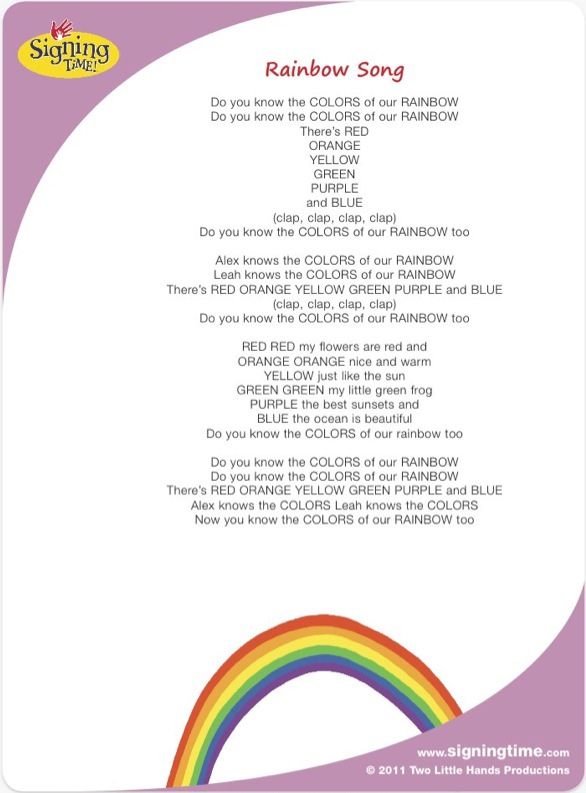 |
| Singing TIme "Rainbow Song" Lyrics | signingtime.com |
Subscribe to:
Posts (Atom)